

Restore Wizard (Preview)
Step 1: Select Records
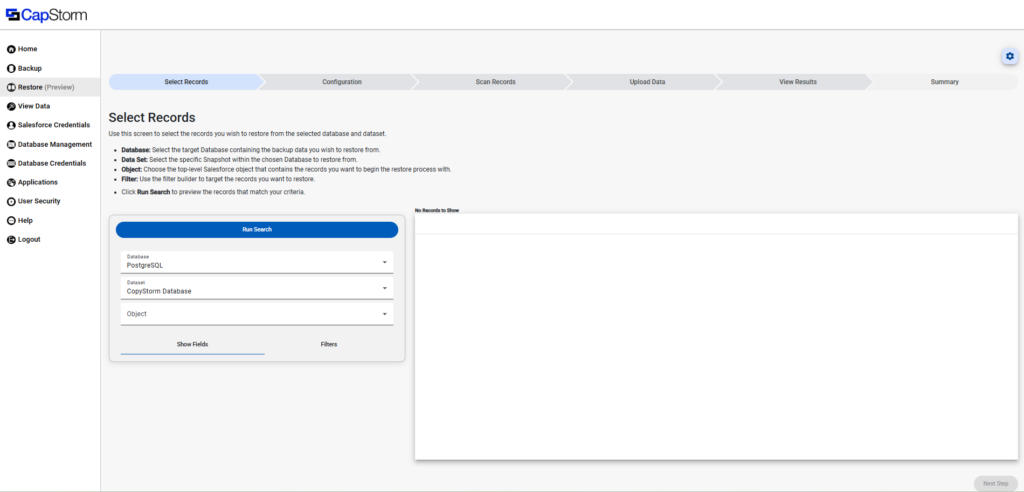
This stage is where you choose what you want to restore-starting from a specific backup (database + snapshot), down to the Salesforce object and the record set you care about. CapStorm/Container’s job is to back up Salesforce into a relational database and support recovery back into Salesforce.
Before You Start
To successfully select records, you generally need:
- A running CapStorm/Container environment you can log into. A CopyStorm backup database available/managed in the container. (Databases are typically created/managed under Database Management.)
- Database connection info registered (so the container can access the backup database).
- Salesforce credentials configured in the container (used in later stages when writing back to Salesforce).
What you see on this screen
The page is split into two main areas:
- Left panel: where you define your restore search (Database, Data Set, Object, Fields, Filters).
- Right panel: a results grid that previews which records match your criteria (it will show “No Records to Show” until you run a search).
Across the top, the wizard stage tracker shows the overall flow:
Select Records → Configuration → Scan Records → Upload Data → View Results → Summary
Step-By-Step
1) Choose a Database
In the Database dropdown, select the database that contains your CopyStorm backup data.
- If you have multiple backup databases, pick the one that corresponds to the org/data you intend to restore.
2) Choose a Data Set (Snapshot)
In the Data Set dropdown, select the snapshot you want to restore from.
- Think of this as your “point-in-time” choice. CapStorm tools commonly treat snapshots as the specific backup set within a database.
3) Choose an Object
In the Object dropdown, choose the top-level Salesforce object you want to start from (for example: Account, Contact, Case).
- This object becomes the basis for your search + preview results.
4) Pick what you want to see in the preview (Show Fields)
Use the Show Fields tab to control which fields/columns appear in the preview results grid.
- This helps you confirm you’re targeting the correct records before moving forward.
- If you’re not sure what to include, start with obvious identifiers (Name, Email, etc.) and expand as needed.
5) Narrow the record set (Filters)
Switch to the Filters tab to define criteria for the records you want restored.
- Keep filters tight when possible-especially in large orgs-to reduce scanning and make validation easier.
- Example filters (conceptually): Name equals “Acme” or LastModifiedDate greater than .
6) Run the preview search
Click Run Search.
- Matching records will populate in the right-side results grid.
- If nothing appears, loosen your filters (or verify you selected the intended snapshot/object).
7) Proceed
Once your preview looks correct, click Next Step (bottom-right) to advance to Configuration.
Common Gotchas
- “No Records to Show” after Run Search
-
- Your filter may be too restrictive, or the selected snapshot doesn’t contain the records you expect.
- A quick sanity check is using View CopyStorm Data to confirm the object + records exist in that backup.
- Database/snapshot not available
- Confirm the database exists/was created for CopyStorm backups in Database Management and that access is configured in Database Credentials.